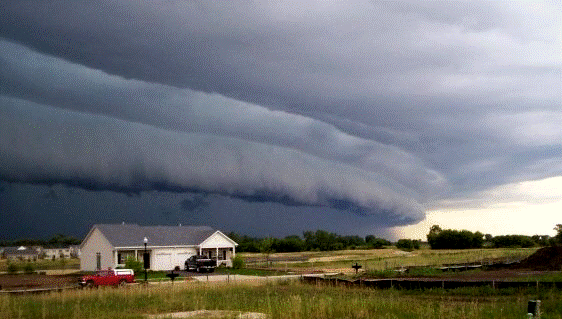
 Extreme weather events are becoming commonplace, from ‘superstorms’ to derechos to clusters of monster tornadoes. And invariably reporters try to pin climate scientists down on the question ‘is it climate change?’, and almost equally invariably, climate scientists appear to waffle, with words like ‘climate change makes extreme weather more likely’ and ‘the probability of storms/floods/tornadoes is increasing’, without actually saying unequivocally that yes, this [insert weather event here] would not have happened in the absence of climate change.
This unwillingness to make a definitive statement of cause and effect may strike many as proof that there is no causal link – that ‘weather happens’ and the amount of carbon in the atmosphere is irrelevant to what we are seeing in the weather today. But that’s because they don’t understand the language of statistics and probabilities.
Many climate scientists use the ‘loaded dice’ analogy to explain the relationship – that climate change is loading the dice in favor of more extremes of weather. I prefer the ‘steroids’ analogy, which goes something like this:
Picture a major league baseball player – he’s a middle-of-the-road player, good enough to make the team but not good enough to be the star. So he starts taking steroids to improve his hitting, and the next season, he hits 28 percent more home runs than he did the year before. Sounds like a lot, doesn’t it? But given how few home runs a player hits in a year, you could be persuaded by the numerically small sample that he simply had a ‘good year’ and was ‘growing into his game’ or whatever the preferred cliché happened to be.
But say you had an omniscient view into the habits of all the players, and you determined that players on steroids on average batted 30% more home runs than players not on steroids. That’s a fairly significant increase and would explain steroids’ appeal to professional players. (These statistics are completely fabricated for the purpose of this analogy, by the way.)
Given this scenario, could you look at a game played by our imaginary player and specify which hits would not have happened if he were not taking steroids? Which home runs were a direct result of steroid use? No, you couldn’t – he’s hit home runs before, and there are so many variables (skill of the opposition, striking angle and strength, even diet and mood) that you simply can’t say this particular hit would have not been long or strong enough to be a home run without the steroids.
Similarly, an individual hurricane during one particular storm season can’t be pinned on global warming – there have been years with more hurricanes, with less hurricanes, with stronger and with weaker hurricanes, el nino years and la nina year, and so on. What climate models do tell us, however, is that the extremes will become more extreme. More energy in the atmosphere means more energy in the pool of energy every storm system draws from, and some are going to get more than others.
So the fact that climate scientists will not blame climate change for specific weather events does not mean that climate change did not cause or contribute to them – simply that we cannot tell which ones are made possible by, or made more extreme by, climate change, which acknowledging that the number of extreme events is increasing.
Like all analogies, this one is inexact. For instance, there is an upper limit to how much improvement in performance a steroid-taking baseball player can expect to gain. The upper limit on climate change’s effects on our weather is the destruction of the food chain and potential catastrophic extinction. So the analogy falls down there.
Still, I hope this little analogy is useful when listening to climate scientists discussing discrete weather events that have already occurred. Climate models can tell you little or nothing about individual weather instances, but that should not be taken to mean that the climate isn’t influencing the weather. Because it is – just ask these French farmers.
But how does this relate to resiliency services, you may ask. After all, it is in support of our resiliency services group that we’re tracking climate change at all, and responding to a flood, say, is the same regardless of what caused it, right?
True, but resiliency (a discipline that includes emergency management, disaster recovery, crisis communication, cyber-security and more) encompasses much more than responding to disasters man-made and natural. In fact, most of the work of resiliency services takes place long before the events that impact your organization occur, in planning, mitigation, training and adaption. And here’s where the changing climate’s impact on extreme weather events plays a role. An organization prioritizes which risks to plan for and attempts to mitigate their negative impacts by taking into account both the severity of the impact if the particular event occurred and some estimation of the likelihood that the event would even happen. For example, you would probably be more likely to plan for, and reduce the harm caused by, a hard-drive crash, than to plan for the occurrence of a 100-year flood. Because even though the negative impact of a 100-year flood would be magnitudes higher than the negative impact of a hard-drive crash, the crash is many times more likely to occur on any given year than a 100-year flood.
Climate change is increasing the impact of extreme weather events, by making the events on the extreme end of the weather spectrum even more extreme, and in many cases increasing the likelihood of them occurring in the first place. In the case of flooding in particular, designations such as ‘100-year flood’ (which is a short-hand way of saying an area has a 1 percent chance of flooding in any given year) are arrived at by examining the recent past, usually no more than ten years. While that was adequate in a stable climate, it is no longer true that the past will remain a good predictor of the future. But since flood probabilities are calculated based (so far) only on the past, much of the actual risk – the portion captured in ‘likelihood’ – is hidden.
Fortunately many planners and developers are already taking future projections into account in their designing and land-use plans. This will become increasingly critical on the coasts and river floodplanes, and in particular on the East Coast, where sea levels are rising faster than the global average, attributed to the slowing of the Gulf Stream.
As resiliency specialists, we have to be aware of not only the historical record, but of what can reasonably be presumed to be the future situation. I’ll talk about the expected near term impacts of climate change to your organization’s resiliency in a later post.
 The Corner Streetlamp